WiMAX will enable mobile Web 2.0  

At the Computex technology trade show yesterday, Intel executive Sean Maloney said that “the convergence of mobile computers, WiMAX wireless broadband, and powerful, HD-rich computer technologies point to a tremendous growth opportunity.”

Maloney unveiled new versions of Intel chipsets that will will bring the Internet to new users. “People have an innate desire to be ‘connected’ all the time and see personalized, mobile technology as the way to meet that need,” Maloney said.

Speed will be one of the key requirements for future mobile technology to deliver the capabilities of Web 2.0, and Maloney said that “Mobile WiMAX is the right solution and it’s happening now.”

In July, Intel is set to introduce processors and chipsets for high-performance laptops with its Intel Centrino 2 (formerly codenamed Montevina) processor technology. An integrated WiMAX/WiFi solution (codenamed Echo Peak) will be available as an option for some Centrino 2 notebook PCs later this year in America.


[get this widget]

Read More...
AddThis Social Bookmark Button

Enforta expansion covers 55 million people  

The Russian WiMAX operator Enforta announced today that it has expanded its network to cover another 22 cities in Russia. These cities begin operation this month, and the company said that another ten cities will be added to its network by Q408. The rapid expansion of Enforta’s network continues with the use of equipment from Alvarion.

[get this widget]

Read More...
AddThis Social Bookmark Button

Google, Cable in $12B WiMAX Deal?  

Sprint, Comcast, Google, Time Warner and Intel will launch a Mobile WiMAX Joint Venture, says the Wall Street Journal. More from NY Times, GigaOm, ArsTechnica and Blogrunnner.


As early as Wednesday, an unlikely alliance of titans from the cable, Internet and chip industries will disclose they are investing $3.2 billion in a company that will deliver Web access for cellphones and laptops at speeds much faster than what is available today using a technology called WiMax.

Analysts say the venture, valued at more than $12 billion, will have a two year head-start on rivals Verizon Wireless and AT&T Inc., which are just beginning to sketch out plans for their next-generation wireless networks.

The deal gives the cable operators and Google prominent roles in shaping the future of mobile Internet access. The venture must still be approved by federal regulators.

The deal is most of all a coup for Sprint CEO Dan Hesse, who four months ago was charged with rescuing Sprint from near-disaster.

“It’s sort of like, ‘Dan, you haven’t vacuumed the bedroom,”‘ Mr. Hesse said. “Well, that’s because the house is on fire. I will get around to it later.”

Last January, Mr. Hesse called Comcast Chief Executive Brian L. Roberts to explore a deal. Mr. Roberts was receptive, partly because he thought the new Sprint CEO might be easier to work with, and partly because he was beginning to see WiMax as an opportunity to confront his own strategic dilemma.

In early February, Mr. Roberts took a trip out to Portland, Ore., to test Clearwire’s nascent WiMax service there and meet with Mr. McCaw. He came away impressed with the technology, say people familiar with the meeting.

Mr. Hesse leaned on Mr. Roberts to round up other cable operators, including Time Warner Cable and a regional provider, Bright House. The cable executives raised several concerns, people familiar with the meeting say. The most pressing issue: They wanted to make sure the new company would be able to use Sprint’s existing “third generation” broadband network until the WiMax network is nationwide, which could take a few years.

Reeling in Google proved especially difficult. Google CEO Eric Schmidt wouldn’t return Mr. Hesse’s phone calls. Mr. Roberts, who had developed a close relationship with the Google CEO, stepped in. He made a pitch on Mr. Hesse’s behalf, then connected the two via email to get a discussion going, according to people familiar with the matter. Mr. Hesse promised to make Google the preferred software developer on the WiMax network, meaning its search service would be the default on new mobile devices.

At times, the sessions got heated. At one meeting in the New York offices of law firm Kirkland & Ellis, Clearwire Chief Executive Ben Wolff was so frustrated with the lack of progress that he pulled his team from the room, shouting “That’s it, the deal’s off,” according to a person at the meeting.

By mid-March, the outlines of a deal were in place, though it would take two more months to iron out details. The new company secured $1.05 billion from Comcast, $1 billion from Intel, $500 million from Google, $550 million from Time Warner and $100 million from Bright House.

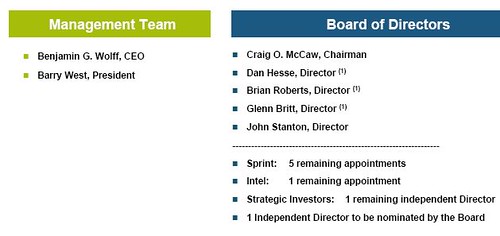
Sprint will hold a majority stake in the new venture. Mr. Hesse agreed to give up day-to-day control to Clearwire’s Mr. Wolff, who is slated to be CEO. Mr. McCaw is expected to be named chairman. The new company will take on Clearwire’s name.

Not mentioned was the mobile tv component. Perhaps Craig McCaw’s ICO G-1 will be drafted for DVB-SH. When ICO’s mobile TV service goes live in 2009, it will focus on in-vehicle displays with larger screen resolution and 10 to 15 channels at 500 kb/s channel, plus two-way capabilities for vehicle navigation and emergency two-way calling and messaging.

But if Sprint spins off WiMAX, sells Nextel and DT buys Sprint, what would be left?


And you may ask yourself
Where does that highway go?
And you may ask yourself
Am I right?…Am I wrong?

Into the blue again/after the money’s gone
Once in a lifetime/water flowing underground.


[get this widget]

Read More...
AddThis Social Bookmark Button

It’s Official: Sprint, Cable & Google Building WiMAX Network  

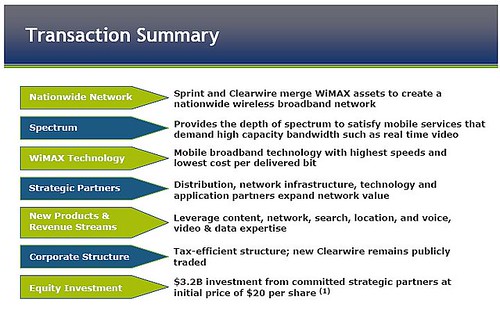
It’s official. Sprint and Clearwire announced this morning they will form a nation-wide WiMAX network, with partners Comcast, Time Warner Cable, Intel, Google and cable operator Bright House Networks who are expected to kick in $3.2 billion to help finance the venture.

The deal (pdf), announced on Wednesday, will provide funding for Sprint and Clearwire to build the network and allow cable providers to offer wireless services to help them compete with rivals AT&T and Verizon. It will use Sprint’s existing broadcast wireless towers and its wired fiber network. Sprint spends some 30% of its $20 billion annual wireless operating costs on backhaul.

Clearwire will be the only company allowed to sell 4G access as a standalone service, according to Sprint CTO Berry West. Sprint will essentially access the network as a mobile virtual network operator (MVNO), selling combined 3G and 4G access plans. Clearwire CEO Ben Wolff told the Seattle Times that, ultimately, the company could “get to 20,000 or 30,000 employees” nationally. Clearwire has about 2,000 employees now, including 350 to 400 at its Kirkland headquarters. Sprint has about 700 in its WiMax unit, including a research and development group in Herndon, Va.

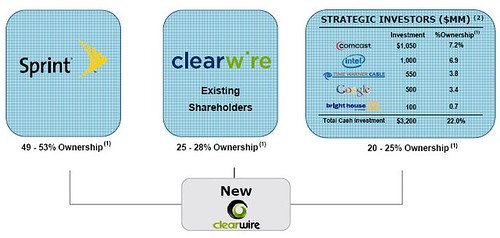
Sprint, which had earlier said they’d spend some $5 billion by 2010 building their WiMAX network across the United States, will now own about 51 percent of the new company. Sprint’s new partners will invest some $3 billion. Clearwire will own about 27 percent. Comcast, Time Warner Cable, Intel, Google and Bright House will get a combined 22 percent.

Google will embed its Android operating system for mobile phones. Google will also be the search provider for the company’s WiMax services.

Intel will work with manufacturers to embed WiMax chips into its Centrino 2 processor for laptops and mobile Internet devices and will market the new company’s service in association with its own brand.

The partners have put the value of the deal at $12 billion, a figure that includes radio spectrum and equipment provided by Sprint Nextel and Clearwire, and $3.2 billion from the others involved.

The investments by other participants include $1.05 billion from Comcast, $1 billion from Intel, $550 million from Time Warner Cable, $100 million from Bright House, a cable provider, and $500 million from Google. Trilogy Equity Partners, intends to invest $10 million, according to a person briefed on the arrangement.

Analysis by Juniper Research indicates up to 12% of the global DSL installed base will be substituted by WiMAX by 2013. The Far East will lead with over one fifth of the 47 million subscribers in 2013.


[get this widget]

Read More...
AddThis Social Bookmark Button

It’s Official: Sprint, Cable & Google Building WiMAX Network  

It’s official. Sprint and Clearwire announced this morning they will form a nation-wide WiMAX network, with partners Comcast, Time Warner Cable, Intel, Google and cable operator Bright House Networks who are expected to kick in $3.2 billion to help finance the venture.

The deal (pdf), announced on Wednesday, will provide funding for Sprint and Clearwire to build the network and allow cable providers to offer wireless services to help them compete with rivals AT&T and Verizon. It will use Sprint’s existing broadcast wireless towers and its wired fiber network. Sprint spends some 30% of its $20 billion annual wireless operating costs on backhaul.

Clearwire will be the only company allowed to sell 4G access as a standalone service, according to Sprint CTO Berry West. Sprint will essentially access the network as a mobile virtual network operator (MVNO), selling combined 3G and 4G access plans. Clearwire CEO Ben Wolff told the Seattle Times that, ultimately, the company could “get to 20,000 or 30,000 employees” nationally. Clearwire has about 2,000 employees now, including 350 to 400 at its Kirkland headquarters. Sprint has about 700 in its WiMax unit, including a research and development group in Herndon, Va.
View Upload your own
Sprint, which had earlier said they’d spend some $5 billion by 2010 building their WiMAX network across the United States, will now own about 51 percent of the new company. Sprint’s new partners will invest some $3 billion. Clearwire will own about 27 percent. Comcast, Time Warner Cable, Intel, Google and Bright House will get a combined 22 percent.
Google will embed its Android operating system for mobile phones. Google will also be the search provider for the company’s WiMax services.

Intel will work with manufacturers to embed WiMax chips into its Centrino 2 processor for laptops and mobile Internet devices and will market the new company’s service in association with its own brand.

The partners have put the value of the deal at $12 billion, a figure that includes radio spectrum and equipment provided by Sprint Nextel and Clearwire, and $3.2 billion from the others involved.
The investments by other participants include $1.05 billion from Comcast, $1 billion from Intel, $550 million from Time Warner Cable, $100 million from Bright House, a cable provider, and $500 million from Google. Trilogy Equity Partners, intends to invest $10 million, according to a person briefed on the arrangement.

Analysis by Juniper Research indicates up to 12% of the global DSL installed base will be substituted by WiMAX by 2013. The Far East will lead with over one fifth of the 47 million subscribers in 2013.

[get this widget]

Read More...
AddThis Social Bookmark Button