Camphone Compression & WiFi Mapping  

PixSense today announced the launch of their new location tagging feature, Media Map. It automatically captures the geographic location and the time that photos or video were taken by the subscriber’s cell phone.

The captured data is automatically integrated with an online interactive map. It is also added to the subscriber’s online gallery where it can be effortlessly categorized by date/time, location, or event. Subscribers can send an entire album based on a trip or specific timeframe to friends.

Location tagging is a one-click feature, with media saving, sharing, web posting and mobile community building. Photos and videos captured on a subscriber’s cell phone can be uploaded to the online media or social networking site of their choice. Subscribers are able to share any mobile media from cell phone to cell phone, cell phone to web or web to cell phone.

If an image stored on the site is too large to be seen on the phone, the company’s technology converts it to the proper viewing size. The phone images can be sent to a variety of sites, including one PixSense operates but also to blogs, MySpace, Facebook or even to CNN.


The photo on the left was originally 2.7 MB in size and was compressed 89%
using PixSense BioCompression technology to 240 KB with little quality loss.

At the core of PixSense’s PSP infrastructure is the patent-pending Bio-Compression technology that provides real-time, on-device media compression to reduce the media data size by up to 90 percent before transfer. PixSense technology is being demonstrated at the 2008 Qualcomm BREW Conference next week. Compression makes a lot of sense for cellphones. Handsets with 2+ Megapixel cameras often use plastic lenses with terrible quality. Wireless Week reviews ways to share your cellphone pictures.

Speaking of location information, Dash GPS, a stand-alone GPS product, also provides real-time traffic info. It uses Skyhook’s Wi-Fi Positioning System. Dash sells the device for $399 and charges $12.99 per month for the wireless service.

The Dash Express wirelessly connects using both cellular and Wi-Fi radios. For cellular, Dash uses a cellular network composed of multiple carriers, so its coverage range is larger than any single national carrier (see map). It uses Open Moko, the open source Linux platform that enables independent developers to create applications for the device. Taiwanese electronics maker Mio Technology is developing similar products.

According to Wirefly, the Top 10 hottest cell phones for travel this summer are:

  1. BlackBerry Curve 8310 –AT&T (with GPS)
  2. Palm Centro – Sprint (with GPS)
  3. LG Vu CU920 – AT&T
  4. T-Mobile Dash –T-Mobile
  5. BlackBerry Pearl 8120 – T-Mobile
  6. Motorola i880 – Nextel (with GPS)
  7. LG Rumor – Sprint*
  8. Motorola v3m RAZR – Verizon Wireless (with GPS)
  9. LG Voyager VX10000 – Verizon Wireless (with GPS)
  10. LG Scoop – Alltel (with GPS)

Gizmodo is reporting the much-anticipated 3G iPhone (with built-in GPS) will be launched on June 9 at Apple’s Worldwide Developers Conference.

Nokia is eyeing wider usage of Linux in cellphones, especially in their $455 N-810 WiMaX tablet (with built-in GPS).


[get this widget]

Read More...

AddThis Social Bookmark Button

Proxim APs Go High Security  

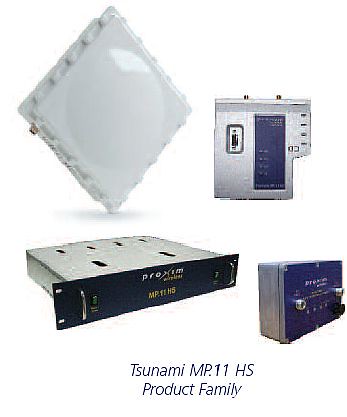
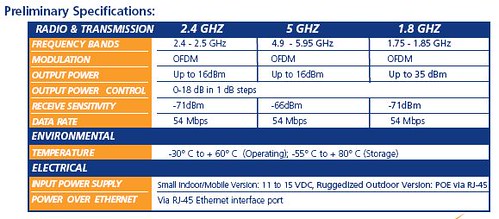
Proxim Wireless, today announced the Tsunami MP.11 HS (High Security) line of base station units, subscriber units and bridges. The new products provide FIPS 140-2 level 2 compliant point-to-point and point-to-multipoint products in the 5.1-5.95 GHz, 4.9 GHz, 2.4 GHz, and 1.8 GHz frequency bands.

The Tsunami MP.11 HS product family is Proxim’s ultra-secure broadband wireless solution for wireless video, data connectivity, VoIP and mobility, combining FIPS 140-2 level 2 compliance, advanced AES-256 encryption, and secure management to meet strict U.S. Federal Government standards.

Proxim’s integrated solution combines high security with the high throughput, required for bandwidth-intensive video, among other applications. It also enables mobile roaming with seamless handoffs at speeds of up to 120 mph (200 km/hour)

Originally designed for “a government client”, utilizing NATO’s 1.8 GHz frequency band (near cellular channels), Proxim decided to commercialize their FIPS 140-2 certified gear using more common frequencies for public service users. The MP.11 HS utilizes the mid 5 GHz band (with some 230 Mhz capacity), and the dedicated 4.9 Ghz public safety band (with some 50 MHz capacity) as well as the more common 2.4 and 5.8 GHz bands.

The Federal Information Processing Standard (FIPS) 140-2, standard is a U.S. government computer security standard used to accredit cryptographic modules. The cryptographic modules are produced by the private sector or open source communities for use by the U.S. government and other regulated industries (such as financial and health-care institutions) that collect, store, transfer, share and disseminate “sensitive, but un-classfied (SBU)” information.

Proxim says the Tsunami MP.11 HS series minimizes system latency with Proxim’s proven WORP (Wireless Outdoor Routing Protocol) and optimizes WiMAX Quality of Service (QoS)

The new Tsunami MP.11 HS product family includes two new subscriber units, two new base station units (one outdoor unit and one rack-mounted indoor unit), the Tsunami QuickBridge.11 HS bridge, a mobility kit and a 1.8GHz converter amplifier.

All MP.11 HS platforms are FIPS 140-2 level 2 compliant, and FIPS 140-2 level 2 certification is in process and is expected in the third quarter of 2008. The subscriber units and base station units each come in both ruggedized POE-enabled and traditional 12-volt DC powered models. Tsunami MP.11 HS products are available for order now.


[get this widget]

Read More...
AddThis Social Bookmark Button

WiMAX World EMEA  

WiMAX World Europe, May 19-21 (program), will feature 110+ Speakers, 30+ Operators representing 25 countries, and 150+ Sponsors and Exhibitors. It is the longest running, WiMAX and Wireless Broadband exhibition for the entire EMEA region (Europe, Middle East, Africa).

Among the announcements:

  • The Asus Atom-based Eee PC 901 will NOT be available to consumers with Mobile WiMAX, reports Digitimes. Instead it will have Bluetooth and WiFi in addition to the new case design. The Eee-oriented WiMax module instead will go to service providers who will offer Eee PCs as part of or alongside their WiMax airtime packages - rather than individual buyers.
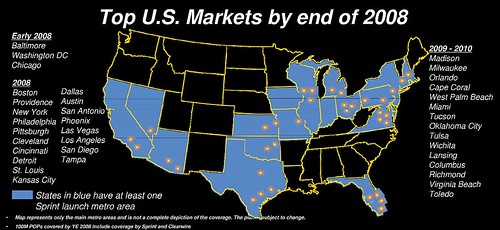
  • Nokia’s handheld N810 will be the first device designed to run on a new high-speed WiMax network by Sprint Nextel. The 4.13-inch touch screen device, similar to the first N810, which went on sale in the fall, will have both Mobile Wimax and WiFi.
  • SEQUANS Communications announced availability of its newest chip, the SQN1170, which integrates baseband, RF, and memory in a single chip. Sequans also announced that Mitsumi, leading system-in-package module maker, is the first to use the chip to develop an SDIO module comprising full Mobile WiMAX system functionality. The SD card module is the first of several modules Mitsumi is developing based on Sequans’ SQN1170. It is the sixth Mobile WiMAX chip Sequans has delivered, following a Mobile WiMAX Wave 1 chip in 2006, two baseband Mobile WiMAX Wave 2 chips in 2007 and two RF chips (2.5 GHz and 3.5 GHz). The SQN1170 can be used to build all types of mobile devices–from mobile phones to embedded PC applications to SDIO modules for consumer electronics devices.
  • Chip designer Wavesat debuted today a new multicore DSP architecture capable of handling baseband processing for multiple broadband networks. The Odyssey 8500 can tackle WiMax Wave 2, 802.11bg and next-generation Personal Handyphone networks. The company will add support for Long Term Evolution cellular in its next generation. “We believe multimode is where the market will go,” said Vijay Dube, executive vice president of marketing at Wavesat (Dorval, Canada). “SK Telecom is one of our investors, and they see blanket 3G coverage with WiMax hot zones in Korea,” he added.
  • Intel on Monday announced a US$15.3 million investment in Green Packet, the parent company of Malaysian WiMax operator Packet One Networks. The operator will offer the mobile version of WiMax and use the 2.3GHz spectrum.
  • Covad says it will begin rolling out a fixed WiMAX wireless broadband offering this year, with a promise of offering data speeds of 6 Mbs. Covad says its decision to offer the service followed a lab test and field trial in San Francisco. Now the carrier will install WiMAX equipment at existing base station locations in the Bay area as well as in Los Angeles and Orange County. In February, Covad agreed to test a WiFi network in San Carlos, Calif., as part of the struggling Silicon Valley Network, that ambitious WiFi initiative that aims to blanket 1,500 sq. miles with WiFi.
  • Tranzeo Wireless introduced a new low cost, turn-key 5.8GHz WiMAX pico-base station. Like its 3.5GHz pico-base station, the TR-WMX-5.8-pBS is designed for broadband service providers seeking to cost effectively accommodate the unique requirements of rural and enterprise customers. Combined with Tranzeo’s existing family of 5.8GHz WiMAX subscriber units and Proximetry’s network management software, it is said to provide a comprehensive, flexible and turn-key last-mile solution.


[get this widget]

Read More...
AddThis Social Bookmark Button

AT&T: We Like HSPA  

AT&T said Wednesday it plans to boost the speed of its 3G wireless network to speeds of 20 megabits per second in 2009, extending the lifetime of 3G.

Speaking at the Morgan Stanley’s annual Communications Conference, the company’s mobility chief Ralph de la Vega said engineers already have a version of AT&T’s HSPA 3G network up and running in the labs at speeds of 7.2 megabits per second.

AT&T plans to transition to HSPA release 7 sometime in 2009. He said the upgrade will require few if any hardware modifications to the company’s infrastructure and achieved largely through a software upgrade to its electronics.

De la Vega also said that his firm has “a clear and logical path” to 700MHz 4G access via the Long Term Evolution (LTE) standard in the 2010 timeframe which should again increase speeds fivefold “to nearly 100 megabits per second”.

“LTE will allow for backwards compatibility to GSM and HSPA, which is a great benefit to customers. And our path forward to LTE allows us to get there step-by-step, with interim steps that will deliver more and more speeds everyday.”

Of course LTE is not yet a standard. Mobile WiMAX is. The 100 Mbps version (802.16m) will be backware compatible with the existing devices. LTE will require new phones and new basestations. New everything, essentially.

Currently, AT&T’s USB data card costs $99 and $60/month for unlimited usage, Sprint’s USB EVDO modem costs $99, plus $60 a month and Verizon charges $149 for their USB modem and $60-per-month — but only for 5Gb per month. Beyond that, it charges a stunning 49 cents per Mb. Speeds using cellular-based EVDO Rev A and HSPA rarely get beyond 1 Mbps.

Clearwire CTO John Saw says backhaul of WiMAX networks require 30-60 Mbps per site with blanket coverage of the entire 700 sq mile Portland region requiring WiMAX nodes installed on some 80 cell sites. Nortel is supplying VoIP infrastructure and services for Clearwire using their Application Server 5200 to deliver SIP applications.

Barry West, the CTO of Sprint’s Xohm business took the WiMAX critics head-on at the WCA, particularly companies that have adopted LTE as their next-generation technology. Noting that LTE services are years away, West accused the LTE camp of “not having anything to offer”. West says WiMAX has “19 companies offering chipsets, 28 companies offering devices, and 29 companies offering infrastructure.

Tony Melone, CTO of Verizon Wireless told Dan Jones of Unstrung [with a straight face] that they’ll begin deploying LTE in 2009 (video).


[get this widget]

Read More...
AddThis Social Bookmark Button

WiMAX will enable mobile Web 2.0  

At the Computex technology trade show yesterday, Intel executive Sean Maloney said that “the convergence of mobile computers, WiMAX wireless broadband, and powerful, HD-rich computer technologies point to a tremendous growth opportunity.”

Maloney unveiled new versions of Intel chipsets that will will bring the Internet to new users. “People have an innate desire to be ‘connected’ all the time and see personalized, mobile technology as the way to meet that need,” Maloney said.

Speed will be one of the key requirements for future mobile technology to deliver the capabilities of Web 2.0, and Maloney said that “Mobile WiMAX is the right solution and it’s happening now.”

In July, Intel is set to introduce processors and chipsets for high-performance laptops with its Intel Centrino 2 (formerly codenamed Montevina) processor technology. An integrated WiMAX/WiFi solution (codenamed Echo Peak) will be available as an option for some Centrino 2 notebook PCs later this year in America.


[get this widget]

Read More...
AddThis Social Bookmark Button